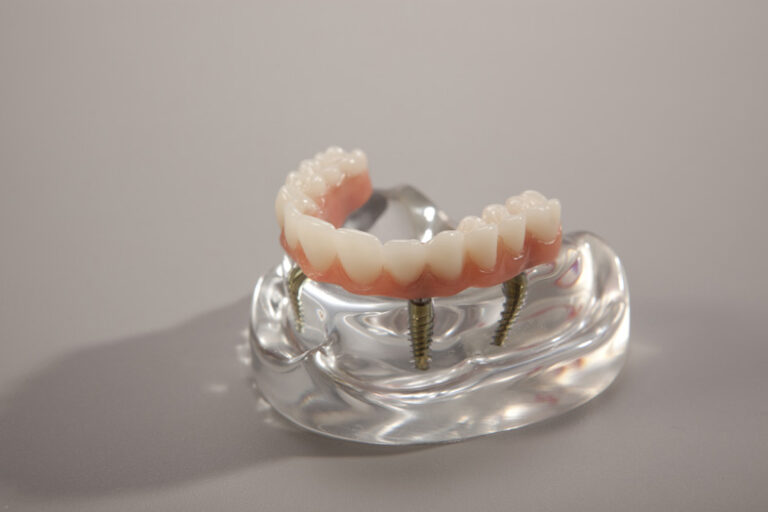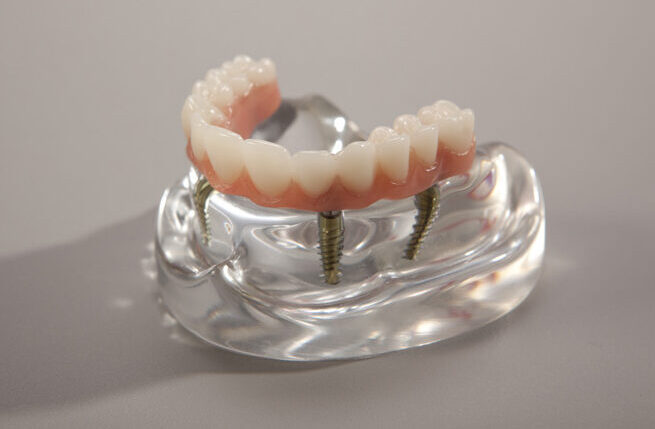
All-on-4 implants differ from traditional dentures in one fundamental way: They are permanently fixed in your jaw. Rather than resting on your gums or relying on adhesives, four titanium implants anchor a full arch of replacement teeth directly to the bone. The result feels and functions much like natural teeth. This article covers how the procedure works, how it compares day to day, who it suits best, and what the treatment journey looks like.
What are All-on-4 implants, and how do they actually work?
All-on-4 implants are a permanently fixed dental solution that replaces an entire arch of teeth using just four strategically placed titanium implants per jaw. Those implants act as anchors for a bridge of 12 to 14 teeth, often completed in a single day. Unlike removable options, the prosthesis stays in place around the clock.
The four implants are not placed straight down like fence posts. Two are angled toward the back of the jaw, which allows them to engage more bone and provide a stable foundation even for patients who have experienced some bone loss. Once the implants are in position, a full-arch prosthesis is attached, and you leave the office with a functional smile that same day.
How do All-on-4 implants differ from traditional dentures in daily life?
The most noticeable difference is stability. Traditional dentures can shift when you eat or speak, which many people find frustrating and sometimes embarrassing. All-on-4 implants do not move. You can bite into an apple, laugh freely, and hold a conversation without worrying about your teeth.
There are no adhesives, no soaking overnight, and no removable plates. You brush and floss your All-on-4 teeth just as you would natural ones. Beyond convenience, the implants also help preserve the jawbone. Traditional dentures sit on top of the gums and do nothing to prevent the bone loss that naturally follows tooth loss. Because All-on-4 implants are anchored in the bone, they provide the stimulation needed to slow that process.
Who is a good candidate for All-on-4 implants versus traditional dentures?
Most adults who are missing most or all of their teeth in one or both arches are worth evaluating for All-on-4 implants. Good overall health, the absence of uncontrolled systemic conditions, and enough jawbone to support four implants are the key starting points. The angled placement technique makes this option accessible even for patients with moderate bone loss who might not qualify for conventional implants.
Traditional dentures may still be the right choice for patients who are not surgical candidates because of health conditions or for those who prefer a non-surgical path. Age alone is rarely a disqualifying factor. A thorough consultation, including imaging of the jaw, is the most reliable way to determine which option fits your situation. There is no single answer that applies to everyone, and a good dental team will help you weigh your options honestly.
What does the All-on-4 treatment process look like from consultation to final smile?
The process begins with a comprehensive evaluation that includes X-rays or a cone-beam scan to assess bone structure and jaw anatomy. From there, a personalized treatment plan is developed so you know exactly what to expect before anything begins. All-on-4 implants are placed during a single surgical appointment, and a temporary full-arch prosthesis is attached the same day.
A healing period follows, typically several months, during which the implants fuse with the bone. Once that integration is complete, the final, permanent prosthesis is fitted. Many patients enjoy their All-on-4 results for 10 years or more with proper care.
If you are ready to explore whether this option is right for you, we would love to help. Request an appointment with our team at Ocean Dental & Aesthetics in Hilton Head, and we will walk you through your options with care and no pressure.